The Labour Welfare Fund Act (LWF), 1965 – Brief Notes

The labour welfare fund is a fund i.e. a statutory contribution maintained by individual state authorities. Frequency and amount of contribution are decided by the state labour board. This contribution differs from state to state. In some states like Tamil Nadu, Andhra Pradesh, Haryana etc. contribution to this fund is made annually. It is social security legislation which is used to improve the conditions of the labours.
 
The contribution to this fund is made by employees, employers and in some states by the government. This Act has been implemented only in 15 states which also includes Union territories. This Act is not applicable to all categories employees, the application may depend on the designation and wages earned by the employees and may differ from state to state.

[Suggested Read: 11 SC Judgments]

The money from the Labour Fund may be utilised for the following purposes-
a)    Vocational training.
b)    Educational facilities for the children of the workers.
c)    medical facilities for their workers and their families.
d)    Housing facilities etc.

  • To cover the employees of the unorganized sector left out by legislation like Employees Provident Fund Act, the government constituted the Labour welfare fund and under this, there are five specific finds established for various non-coal mines workers, beedi and cine workers. 
  • The contribution to the fund may be made annually or monthly. The employer is responsible for deducting the contribution from the salary and submit it to the authority in time. 
  • The fund may be utilized for providing educational facilities to children of workers, medical facilities for workers and their families, recreational schemes in the office, housing loans, vocational training etc. 
  • The constitution of the fund is for the purpose of improving industrial relations between the workforce and the employer, to reduce unrest and promote unity. 
  • If a woman has worked for 6 months and more continuously, she is entitled to claim Rs. 1000 as maternity benefit for the first two deliveries.

[Suggested Read: Shops and Commercial Establishments Act (S&E), 1961 – Brief Notes]

The Employees State Insurance Corporation Act, 1948 (ESIC)

It is social security legislation which provides benefits in terms of maternity leaves, sickness, injury caused. It is applicable to establishments where 20 or more persons are employed or were employed on any day in the preceding 12 months. It is applicable to employees drawing a salary not exceeding Rs. 21,000 per month.

Once the Act becomes applicable to the factory or establishment the employer must get the factory or establishment registered with the Employees State Insurance Corporation within 15 days. It is a self-financing health insurance scheme. 

[Suggested Read: Shops and Commercial Establishments Act (S&E), 1961 – Brief Notes]

According to a recent development, a Universal Social security Code will be established which will divide the workers into four categories. The Code looks forward to repealing the Employees State Insurance Corporation Act and the Employees Provident Fund Act. A welfare Board will be created for organised and unorganised workers. Unorganised workers will have to pay 12% of the wages and organised workers will have to pay 17% of the wages towards this fund.

  • Under this Act, full medical coverage is provided to the employee from the date of employment and extends to his/her family. There is no ceiling on the amount. 
  • In case of sickness caused in the course of employment, the employee is entitled to cash compensation of the amount of 70% of the wage subject to contribution. It is extendable for even more compensation in case of enhanced sickness. 
  • If the person who has been insured for 3 or more years, is unemployed because of retrenchment, disability or place of employment has closed, then he is entitled to Unemployment allowance of 50% of wage for up to 1 year. 
  • Dependent or person performing last rites of the person is entitled to compensation up to Rs. 10,000.
  • If the death of the employee occurs due to occupational injury or hazard, then the dependants of the person are entitled to compensation of 90% of the wage

[Suggested Read: Labour Rights]

The Contract Labour (Regulation & Abolition) Act, 1970 (CLRA) – Brief Notes

The main aim of this Act is to prevent contract labour exploitation in the hands of the contractor or the employer. Contract labours are different from direct labours. This Act is applicable where 20 or more workmen are employed on any day in the preceding 12 months. This Act does not apply to establishments where work of seasonal nature is carried out. 

Contract labours employed by different contractors and for different purposes have to be taken into consideration for the purpose of calculating the number of employees employed. An application has to be made for registration and obtaining the license if any contractor or employer falls under the purview of this Act. In case, the labour employed is for a short period of 15 days then this Act gives an option of Temporary Registration as well. 

[Suggested Read: Shops and Commercial Establishments Act (S&E), 1961 – Brief Notes]

The Ministry of Labour and employment has recently introduced a category of ‘Fixed Term Employment’ for all sectors in the Industrial Employment (Standing Orders) Act, 1946. The main object of this is to substantially reduce the exploitation of Contract labours as the employer would directly hire the worker without any mediator in the form of contract for a fixed term.

  • The act does not cover the employees at managerial and administrative posts and when the salary is more than Rs1600 per month. 
  • The employee is responsible for the registration of the establishment with Registration officer to obtain a certificate and also to apply for a licence for hiring contract labour. 
  • Under this Act, the contractor is bound to provide facilities such as canteen when more than a 100 labour is contracted, sufficient ventilation and light in work area, resting place for overnight workers, basic medical facilities etc. 
  • The contractor is bound by law to pay the hired labourers their wages in a regular and timely manner. The responsibility shall lie on the Principle Employer if the contractor fails to do so. 
  • The contract labourers also qualify for the benefits of other statues such as Employee Provident fund Act, Factories Act, Payment of Wages, Minimum Wages Act, Industrial Disputes Act, and Workmen’s Compensation Act.

[Suggested Read: Right of Legal Aid in India – 11 Provisions You Must Know]

The Employees Provident Funds and Miscellaneous Provision Act, 1952 (EPF)

It is a welfare scheme for the betterment of the employee. A part of the amount is deposited both by the employee and the employer. The amount is deducted by the employer from the employee’s salary and deposited in the provident fund account. The money which is accumulated is given to the employee on retirement if certain conditions are satisfied.

It is applicable to every establishment or factory where twenty or more persons are employed. It is social security legislation. 12% is contributed by the employee towards the Provident Fund, however, 13.61% is contributed by the employer. The Provident Fund amount and interest is not taxable if the employee withdraws the amount at the time of retirement.

[Suggested Read: Shops and Commercial Establishments Act (S&E), 1961 – Brief Notes]

According to the Amendments made in the Act and as per the Union Budget of 2018, females who are newly recruited have to pay only 8% towards PF as opposed to the earlier 12%. This is available to them for the first three years of employment. The government has also proposed to contribute 12% of wages towards PF or new employees for the first three years of employment.

  • This Act is applicable to all of India except Jammu & Kashmir And is managed by the Employees' Provident Fund Organisation
  • It mandatorily covers all establishments that employ 20 or more people and may, as an exception, include establishments with less than 20 employees. 
  • The employee also has the option of contributing a higher amount voluntarily which is known as the Voluntary Provident Fund (VPF). This, however, is not matched by the employer. 
  • After retirement at the age of 55, the PF can be claimed by the employee which includes the employee and employer's contribution along with the interest incurred on the amount over the years. 
  • An employee can also access the PF before the retirement as 'advances' which is granted in specific situations like medical requirements, loan repayment, education etc. But the amount advanced depends on situation and years of service.

[Suggested Read: Tamil Nadu Terminated Full Time Temporary LIC Employees Association Vs. S. K. Roy, The Chairman, Life Insurance Corporation of India [Supreme Court of India, 09-08-2016]]

Under-Trial Prisoners’ Access to Legal Aid

Government To Bear Expenses for Prisoners’ Right to Free Legal Aid and Legal Representation

Under Article 39A, eligible under-trial prisoners suffering in jails across India may receive free legal aid. Free Legal aid, which includes legal advice, education and representation, ensures equal access to justice for all regardless of financial weakness, social backwardness or any disadvantage of circumstances.

The duty imposed on the state by Article 39A is supplemented by the existence of Legal Services Authority Act,1987 which states that people in custody are entitled to legal aid services dispensed by National Legal Services Authority along with its state and district counterparts. A prisoner can qualify for legal aid at the pre-litigation stage as well at any stage of appeal.

This government endeavour is also supported by various independent NGOs working tirelessly to bridge the gap between the justice machinery and the underprivileged. The Supreme Court has also reiterated that the right to legal representation at the expense of the state is available for prisoners under the purview of Article 21 which guarantees Right to Liberty and Article 14 which guarantees Right to Equality.

Lack of Adequate Legal Representation leads to Unjust Imprisonment

But the reality differs greatly from the ideal as, despite the existence of this onus on the State, the implementation of it is found severely lacking.

Under-trial prisoners find themselves in a precarious condition like lack of legal representation means unjust imprisonment. The jails are overcrowded by people arrested for minor offences unable to access legal aid due to lack of money or awareness. They have to rot away in jails beyond the maximum sentence for their offence despite the law. The justice machinery meant for the welfare of the society ends up being unwarranted shackles at the feet of innocents.

NALSA and the State machinery have been instructed to coordinately set up under-trial review committee since no person is to be detained beyond one-half of the maximum period of imprisonment possible for a particular offence while under trial. NALSA regulations dictate the setting up of legal aid clinics in every prison all over India accompanied by regular visits by lawyers to ensure widespread outreach of their services.

[ Suggested Read: Concept of Legal Aid in India ]

Increase Legal Aid Advocates and Equip them with Mentoring Support and Guidance

However, this system is riddled with deficiencies such as a limited number of lawyers willing to assist for free as opposed to the huge amount of pending cases. The odds are as bad as one lawyer being available for more than 18000 prisoners. Although legal aid clinics have been set up in most of the jails, their effective and successful functioning is another matter altogether. There are instances of delay in assignment of a lawyer to an applicant and on an average, it takes 11 days but more than 20% cases took more, some even took a month.

Even after assignment, there is no guarantee of immediate action. At times, the prisoner is assigned a negligent lawyer. There is no guarantee that a competent and experienced lawyer equipped to handle the case is employed. The Legal Services Institutes have constituted committees for reviewing and monitoring the quality but that has proven to be no easy task as there is no complaint mechanism. Inquiries have revealed that on paper legal aid personnel have been appointed in almost all the states, but they have failed to increased access on the grass-root levels, accompanied by an underwhelming number of prison visits by lawyers. Furthermore, it has been brought to light that even though the machinery is well funded, there are instances of disappointing performance by authorities and unspent fund money.

[ Suggested Read: Right to Legal Aid and Access to Justice ]

Conduct Paralegal Training and Awareness Campaigns for Under-trial Prisoner’s Rights to Free Legal Aid

NALSA in 2017 created a special program for the under-trial prisoners under which it digitized all the data on prisoners in jails to identify those without legal representation and Legal aid clinics in those jails were revamped to effectively provide services to prisoners. It has succeeded by providing assistance to more than 4 lakh prisoners until early 2019.

NALSA has made attempts to fill up the shortage of legal aid personnel by training more than 67 thousand paralegals in a year. The numerous awareness campaigns launched across the country have been crucial for prisoners, especially women prisoners. Delhi SLSA has especially commended for its Clinics and campaigns.

[ Suggested Read: Online Legal Help Desk to get free legal advice and solutions  ]

Recommendations to Improve Legal Aid Services for Under-trial Prisoners’ in India

  • The number of legal aid providers needs to be increased along with training programs.
  • A lawyer can be appointed for police stations to reduce unnecessary arrests and facilitate rightful bail.
  • Legal aid lawyers must meet mandatory meet their clients in prison without delay.
  • Assignment of lawyers needs to be quicker
  • Law students can be attached to the lawyers to assist with the case and train them.

By Ayushi Singh, LLB( Hons.) 1st year,

Dr.Ram Manohar Lohia National Law University, Lucknow.

Implementation Failure of Legal Aid Services in India

Image may contain: one or more people and people standing

LEGAL AID

To ensure equal access to justice to every citizen unhindered by weak financial positions or social backwardness, the Constitution provides free legal representation to the people in need. National Legal Services Authority and its State and District branches are established by the legislature to implement this objective. They are supported by free legal clinics and NGOs to provide free legal aid to the people it in the form of advice and information. However, the successful execution of this vision has proved to be ineffective to a degree. The difficulty lies in the extent of grounds to be covered and the quality of services provided for free.

LEGAL AWARENESS

The first category includes the general lack of legal awareness in the masses. Since they are unaware of their own rights, including the right to free legal aid, they don’t seek legal aid for their issues. The Justice machinery is perceived as something beyond their reach and they are, in turn, ignorant of any provisions and schemes available to help them. Moreover, the lack of awareness exposes them to exploitation by the legal personnel appointed to assist them. There have been many instances of the lawyers charging a fee from their free legal aid clients or simply being careless while handling the cases.

INADEQUACY OF THE SYSTEM

Another failure of its outreach is that despite attempts, certain rural and marginalised communities are neglected because of a lack of awareness and absence of legal aid offices in remote areas.

The judicial system is failing to fulfil its purpose of reaching the weaker sections because of the deficient number of lawyers and judges which leaves the courts overburdened. At times, the litigation process is substituted by the Alternate Dispute Resolution techniques like mediation to reduce the burden on courts and settle civil matters congenially. But these services provided by the Lok Adalats also face the problem of settling a large number of cases in a rushed or forced manner where the victim may not get complete justice.

QUALITY OF LEGAL AID

The quality of services provided by the legal representative itself is a major issue in ensuring delivery of justice through the established machinery. Firstly, there is a lack of lawyers to take up cases because there is weak pro-bono inclination. The counsels available sometimes aren’t sincere enough in their duties towards their assigned clients due to the insufficient remuneration. At times, the remuneration provided to them is so insufficient that it doesn’t even cover their incidental expenses, which in turn make them unwilling to provide free aid.  It may also be that the lawyers assigned may be too unskilled or inexperienced to handle sensitive cases. This lack of competence within the system needs to be addressed as well and every legal aid helper, from the lawyers to the law students needs to be trained better. At certain places like Rajasthan, there is a great delay in assignment of a lawyer to the applicant and the clinics and offices may be overburdened by the number of cases at hand, leaving us with inefficient and rushed delivery systems. Hence, the quality of service provided suffers.

RECENT SUCCESS

Nonetheless, all is not lost despite the appalling picture presented by the current circumstances. With times, the existing machinery of free legal aid services consisting of NALSA and its offshoots have made considerable progress and expanded their functions to undertake diverse schemes. NALSA made 2018 a great success and made headway in providing services to more than 14 Lac people, many of whom belonged to the unfortunately marginalised and disadvantaged sections such as scheduled castes, scheduled tribes, women, transgenders and the disabled. Various branches of this organisation collectively held more than 76 thousand legal awareness programmes.

The Lok Adalats held by NALSA and its State branches all over India served their purpose well by dispensing lakhs of cases. Campaigns were launched to address issues of convicts, especially women convicts, and to spread awareness about legal aid services. The Victim Compensation initiative has brought uniform justice to many women and children victims. Overall, it was a year full of goal-oriented programmes that addressed the potholes of the system by revamping the clinics and internship or traineeship programmes for the panel lawyers and law students.

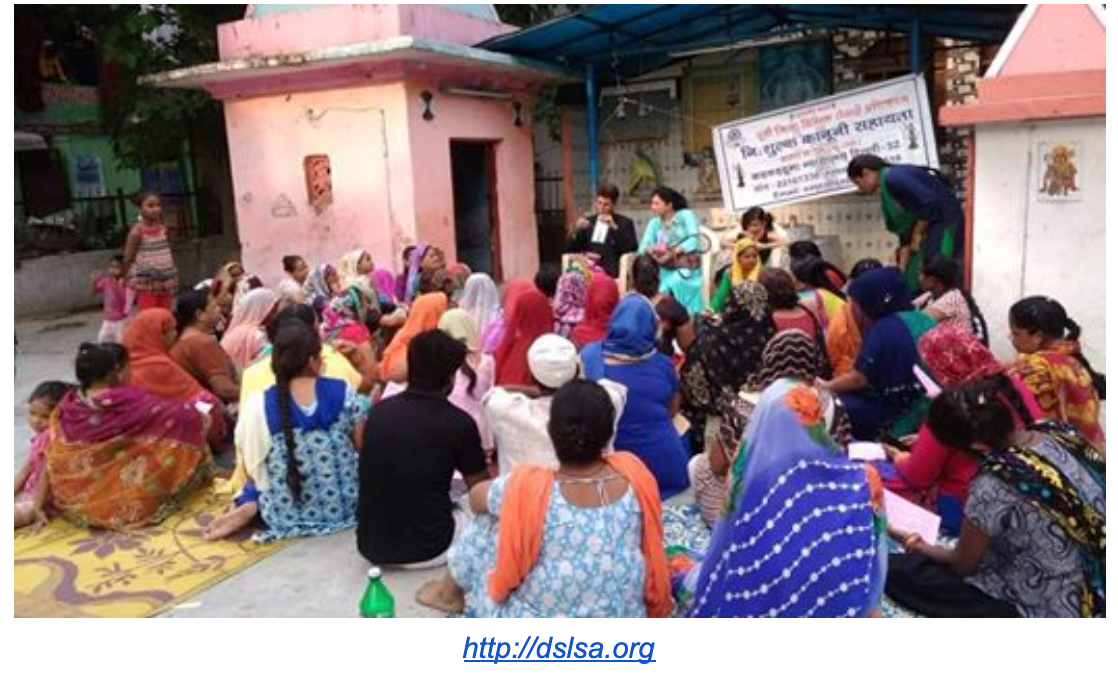
The Delhi State Legal Services Authority was especially commended for their initiative of conducting a Mega Legal Services camp to educate specific communities like Unorganised Labourers, transgenders and Commercial Sex Workers of their rights. They have continued to reach a wide section of people by organising similar awareness programmes for their services and issues such as Child Labour.

SOLUTIONS

  • Spreading legal awareness, through legal literacy camps, is a must to make effective utilisation of the free services.

  • Suggested reforms include increasing the amount of compensation paid to the lawyers

  • Making free legal services to the underprivileged mandatory for the lawyers.

  • Adequate funding of the Legal aid organisations and increased remuneration for the counsels.

  • Extensive training of the legal fraternity involved especially the inexperienced freshers, paralegal training sessions and internship opportunities for the law students so they may obtain hands-on experience and ensure quality services.

  • The cumbersome bureaucratic entanglements such as elaborate rules and interviews need to be removed so as to facilitate the empanelment of passionate young lawyers into the folds when there already exists a dearth of willing legal professionals to provide quality free legal aid to the people.


By Ayushi Singh,

LLB( Hons.) 1st year,

Dr.Ram Manohar Lohiya National Law University, Lucknow.

Child Rights and How to Report Child Abuse

Why Child Rights?

The United Nations Convention on the Rights of the Child (UNCRC) defines a child as a human being below the age of 18. Since children are considered possession of parents in our society and they entirely rely on adults for the fulfilment of all basics needs, they become prone to abuse and exploitation.  Abuse and exploitation at this tender age can have a lifelong effect. Thus the protection of children's rights is important for a healthy future society.

International Guidelines

India ratified the United Nations Convention on the Rights of the Children in 1992. It gives the following rights to children:

  • The Right to an Identity (Articles 7 and 8)
  • The Right to Health (Articles 23 and 24)
  • The Right to Education (Article 28)
  • The Right to a Family Life (Articles 8, 9, 10, 16, 20, 22 and 40)
  • The Right to be Protected from Violence (Articles 19 and 34)
  • The Right to an Opinion (Articles 12 and 13)
  • The Right to be Protected from Armed Conflict (Articles 38 and 39)
  • The Right to be protected from Exploitation (Articles 19, 32, 34, 36 and 39).

Constitutional Rights

Right to equality (Article 14), Right against discrimination (Article 15), Right to personal liberty and due process of law (Article 21), Right to being protected from being trafficked and forced into bonded labour (Article 23), Right of minorities for protection of their interests (Article 29) are some fundamental rights available to adults as well as children. The Directive Principles of State Policy, though not enforceable, provide following guidelines – Protection of the weaker sections from social injustice and all forms of exploitation (Article 46), Duty of the State to raise the level of nutrition and the standard of living and to improve public health (Article 47).

Right to free and compulsory elementary education for all children in the 6-14 year age group (Article 21 A), Right to be protected from any hazardous employment till the age of 14 years (Article 24) are some fundamental rights specifically for children. Some articles in DPSP provide guidelines for the welfare of children. Article 39(e) aims towards the protection of children from abuse and entering avocations unsuited to their age. Article 39(f) seeks for development of children in a healthy manner with freedom and dignity. Article 51 A (k) makes it a fundamental duty of a parent or guardian to provide educational opportunities to his child/ward of age 6-14.

Important laws related to Child Rights

  • Child Marriage Restraint Act, 1929 (Amended in 1979): Applicable to all religions. Restraints child marriage (below 18 for females and below 21 for males).
  • Immoral Traffic (Prevention) Act (Amended in 1986), 1956: It aims at preventing children from trafficking for prostitution.
  • Child Labour (Prohibition and Regulation) Act, 1986: Regulates the working conditions for children in employment and prohibits the working of children in certain kinds of employment.
  • Juvenile Justice (Care and Protection of Children) Act, 2000:  It requires that the state provides free legal support to the juveniles, and proper care and protection is provided to those in need. Provides for a child-friendly approach in adjudication and disposition of matters involving children.
  • Protection of Children from Sexual Offences Act, 2012: This act is against a child (below 18 years) sexual abuse. The framing of the Act seeks to put children first by making it easy to use by including mechanisms for child-friendly reporting, recording of evidence, investigation and speedy trial of offences through designated Special Courts.

Protection against Verbal Child Abuse

Child abuse need not necessarily contain violence. Verbal or emotional abuse can be as harmful and long-lasting as physical abuse. Verbal abuse involves the use of foul and abusive language for a child. A person who suffered verbal abuse in childhood is likely to experience low self-worth and self-esteem.

Verbal child abuse is punishable under the following laws:

  • Section 503 IPC: Verbally threatening a child to cause injury or harm constitutes criminal intimidation. Punishment for criminal intimidation is given under section 506 of IPC.
  • Section 509 IPC: Verbally abusing a girl child to insult her modesty is punishable under this section.
  • Section 294 IPC: Verbally abusing a child in a public place with obscene words is punishable under this section.

How to report Child Abuse?

To report child abuse in India:

  • Online system: Sexual abuse can be reported through the Protection of Children from Sexual Offences (POCSO) e-Box. These reports are received by the National Commission for Protection of Child Rights.
  • Report to police: Child abuse can be reported to the police. Call police helpline for immediate help. FIR will be lodged followed by a further investigation by police. If it so happens the police station refuses to lodge an FIR or to record any information, a copy of such information shall be sent to the Superintendent of the Police or the Assistant Commissioner of Police in writing, along with the statement that the approached Police Station refused to lodge the FIR or record the information in question. A copy of the writing must also be sent to the Commissioner of Police, the Deputy Commissioner of Police and the Senior Police Inspector. It must be noted that the POCSO Act makes it illegal to not report suspected child abuse after witnessing it.
  • Report to NGOs: Many NGOs working for child rights. Child abuse can also be reported to these NGOs for assistance. Some examples are HAQCRC, CRY, Childline India Foundation, etc.

By

Vatsla Shrivastava, I Year LLB
National law institute University, Bhopal

How to Get Anticipatory Bail in India?

Bail implies impermanent arrival of a charged individual anticipating preliminary, in some cases on condition that an aggregate of cash is held up to ensure their appearance in court. At the end of the day discharge or secure the arrival of a detainee on an instalment of safeguard. It might be characterized as security. For example, money, a security, or property, swore or given to a court by or for the benefit of one blamed for carrying out a wrongdoing, to acquire discharge from detainment and to guarantee the individual's future appearance in court when required amid the criminal continuing.

Safeguard is cash or some property that is stored or vowed to a court, keeping in mind the end goal to anchor the discharge from authority or prison of a speculate who has been captured, with the understanding that the suspect will return for their preliminary and required court appearances. From the above, to finish up what safeguard is, as an idea in law, implies a charged is conceded discharge from guardianship fro officers of the law (the police) and into the authority of a man that is ordinarily referred to the blamed as sureties.

Anticipatory Bail – Objectives

The object of arrest and its detention of the accused person is primarily to secure his appearance at the time of trial and to ensure that in case he is found guilty he is available to receive the sentence. If his presence at the trial could be reasonably ensured otherwise than by his arrest and detention, it would be unjust and unfair to deprive the accused of his liberty during the pendency of the criminal proceedings against him.

There is no definition of bail in the code, although the terms "bailable offence" and "non-bail able offence" been defined in section 2A of the code. Bail is the number of money defendants must post to be released from custody until their trial. Bail is not fine. It's not supposed to be used as punishment. The purpose of bail is simply to ensure that defendants will appear for trial and all pre-trial hearings for which they must be present. In bail, we pay a set amount of money to obtain our release from police custody.

The Concept of Anticipatory Bail in India

The concept of anticipatory bail comes into place when the accused may rightfully fear arrest in cases of cognizable offences. Bail is a legal relief that a person may be entitled to in order to get temporary freedom until his case is disposed of. Depending upon the gravity of the charges, a man might have the capacity to stay away from capture out and out. Notwithstanding, there are cases in which capture is made and the denounced is sans set according to the arrangements of the safeguard as given under the criminal system code. In instances of criminal cases, particularly those relating to the endowment, expectant safeguard comes as a help to many charged individual. It is actually connected for fully expecting the capture

[Suggested Read: What are Bail and the grounds for refusal?]

Procedures to get Anticipatory Bail in India

The public prosecutor will talk to the police officer concerned. If there is no fir filed, the Public prosecutor would be of the view that there were no grounds for granting anticipatory bail. The judge will agree to this and your lawyer will be verbally asked to withdraw the anticipatory bail. The lawyer will make an oral prayer for seven days pre-arrest notice in case the police formulate an intention to arrest. In all the above cases, the judge will grant a plea. An order will be passed accordingly. This is called the ‘notice bail' commonly.

If the bail application is rejected in the session's court then it would be applied in the high court. If the high court also rejects the bail, then further application on the Supreme Court is permitted. In cases when the firm has been filed, the investigating officer will send a notice of arrest. As soon as that notice is received, one should apply for anticipatory bail following the same procedure above. The high court or Court of Session may direct that any person who has been released on bail be arrested and commit him to custody on an application moved by the complainant or prosecution in case any of the conditions imposed by the court are being violated.

[Suggested Read: Different Kinds of Bail In India]

Concept of legal aid in India

Legal aid mainly means giving free legal services to the needy people who are unable to afford the advocate for the conduct of the case. The Constitution of India contains the preamble which states the aim to secure people of Indian justice-socio economic and political.

“Legal aid” is a legal support, to the poorer and weaker numbers to enable them to enforce their legal rights through the legal process. Legal aid not only means providing the legal aid within the ambit of the court but it means that providing the legal support within and outside the ambit of the court to the poorer section of the society.

Section 2(a) of the legal aid act, 2000 defines legal aid as providing legal advice, paying lawyers' fees and cost of litigation including providing any other assistance to those who suffer financial insolvency, destitution, helpless or are unable to access justice due to various socio-economic conditions.

The legal aid is not a matter of charity but it is a matter that can be claimed as a matter of right. In the Constitution of India, there was no such express provision which was dealing with the concept of legal aid. But the 42nd Amendment Act, 1976, had inserted a new Article 39(a) in the Constitution of India and a significant step in the direction of the setting up of legal aid. The relevant provisions in the code of criminal procedure and the code of civil procedure have also amended for securing equal and social justice in criminal as well as civil cases.

Importance of legal aid

Nowadays, it has become very costly to take a legal adjudicator and has become very expensive for the average people to afford a legal representative for the case. For example, if a suit is filed where one party is poor and the other party is affluent so the party who is affluent will be able to hear a competent and the best lawyer for the case as compared to the party which is poor. So the lawyer who is the best will won the case so in this case the rule of equality applies and also the rule of law also applies. So for providing justice to the poorer section of the society free legal aid should be provided to the needy.

In the case of Bandhu Mukti Morcha vs. Union of India, the former Chief Justice of India P.N. Bhagwati has observed in this case that where one of the parties to the litigant belongs to the poorer section which does not possess adequate socials and material resources where he is bound to be at the lower level as against a strong powerful opponent. So as long as India is suffering from poverty and poor and needy people are there in our Indian society so there is a need of the free legal aid to them for human rights and also the equality.

Supreme Court on legal aid services

The linkage between article 21 and also the right to free legal aid has forged the decision in Hussainara Khatoon v. The State of Bihar. In this case, the court has declared that that “there can be no doubt that speedy trial, and by speedy trial, we mean reasonably expeditious trial, is an integral and essential part of the fundamental right to life and liberty enshrined in the Article 21“. The court also stated that Article 39a of our Indian constitution states free legal aid to the needy people and its basic inalienable element are “reasonable, fair and just“.

Legal aid is really nothing else but equal justice in action. Legal aid is, in fact, the delivery system of social justice. If free legal services are not provided to such an accused, the trial itself may run the risk of being vitiated as contravening article 21 and we have no doubt that every state government would try to avoid such a possible eventuality”

3 legal aid committees have also been set up for the betterment of the needy and the weaker section of the societies. They are as follows-

  • The district legal aid committee
  • The state legal aid committee
  • The taluka legal aid committee.

Supreme Court Legal Service Committees

The Supreme Court legal services committee has been enacted under the Legal Services Authorities Act, 1987. This committee has been set for the effective rendering of justice in the apex court. If a person belongs to the poor section of the society having an annual income of less than Rs. 18,000/- or belongs to scheduled caste or scheduled tribe and if a victim of natural calamity, is a woman or a child or a mentally ill or otherwise disabled person or an industrial workman or is in custody including custody in protective home, he/she is entitled to get free legal aid from the supreme court legal aid committee.

The aid so granted by the committee includes the cost of preparation of the matter and all applications connected therewith, in addition to providing an advocate for preparing and arguing the case. Any person desirous of availing legal service through the committee has to make an application to the secretary and hand over all necessary documents concerning his case to it. The committee after ascertaining the eligibility of the person provides necessary legal aid to him/her. The persons belonging to the middle-income group i.e. with income above Rs.18000/- but under Rs.120000/- per annum are eligible to get legal aid from the Supreme Court middle income group society, on nominal payments.

So the main concept of providing free legal service is to help the needy people those who are not able to afford an advocate for the justice. As in India, there is a lot of poverty and people are so poor that they are no able to afford an advocate so free legal aid is necessary to those. And the government has also made many provisions for free legal aid. Certain constitutional provisions have also been made for free legal aid.

Different Kinds of Bail In India

Bail in the bailable offence

When any person who is accused for a bailable offence then the person is arrested or detained without warrant by an police officer who is in charge of it, or appears or is brought before a Court, and is prepared at any time while in the custody of such officer or at any stage of the proceeding before such Court to give bail, such person shall be released on bail. In the case of bailable offence, one has to only file the bail bonds and no application is required.

Bail in the non-bailable offence

Non-bailable offences are those offences which are considered as serious offences where bail is a privilege and can only be granted by the court only. If a person is arrested and is under the custody and the accused has done something serious or non-bailable crime, then the person cannot ask to be released on the bail as the matter of the right.

On account of a non-bailable offence, the police can't discharge anybody on safeguard thus the captured individual needs to make an application for safeguard under the watchful eye of a judge or court. Afterthought of elements, for example, the earnestness of the offense, the odds that the blamed will meddle with the examination by altering proof or undermining witnesses or if the denounced is probably going to seek total isolation or leave the nation to get away, the court will choose whether he/she can be permitted to be let out on safeguard or not.

[Suggested Read: What are Bail and the grounds for refusal?]

In the event that somebody is rejected safeguard, he/she can engage a higher court. In the event that the police don't finish their examination within 60 days for a wrongdoing that isn't culpable with death or life detainment, at that point the charged gets safeguard. For offences that are culpable with death or life detainment, the examination must be finished up inside 90 days, or the charged will have the privilege to safeguard.

Anticipatory Bail

Law Commission of India in its 41st report suggested fusing an arrangement for Anticipatory Bail. Section 438 of the Criminal Procedure Code managed the Anticipatory Bail. This provision enables a man to look for safeguard fully expecting a capture on an allegation of the non-safeguard capable offence having submitted by him. It is a course to discharge a man on safeguard, issued even before the individual is captured.

[Suggested Read: How to Get Anticipatory Bail in India?]

3-Stages of Granting the Bail

  • Pre-trial Stage
  • Trial Stage
  • Post-trial Stage

General principles for a Bail

  • No prima-facie case made out
  • No specific over act
  • The benefit of doubt
  • Exceptions under CrPC
  • Delay in lodging FIR
  • Delay in investigation
  • Delay in trial
  • Long detention
  • Bail granted to co-accused
  • Plea of alibi