What is Bail and the grounds for refusal?

Bail is a set of restrictions that are forced on a suspect while pre-trial, to ensure they comply with the judicial process. In the United States, the bail mainly implies to the bail bond. A bail bond is a kind of money or the property which is deposited by a suspect to the court so that the person can be released before the pre-trial detention. And if afterwards the suspect does not present in the court after it then the bail will get forfeited and will be brought up by the charges of the crime of the “failure to appear” in the court of law. In India, the bails are mainly governed by the CrPC (Criminal Procedure Code) which defines whether the offence is bailable or non-bailable.

Bail petition can be filed in different courts such as magistrate court, Court of Session judge, high court division and appellant division.

When Can A Bail Be Refused?

The courts can refuse a person to bail for the following reasons:

  • If the court feels there is a risk of the defendant absconding
  • To prevent the defendant from committing further crimes
  • To prevent the defendant from interfering with witnesses
  • For the defendant's own protection
  • If the defendant is in prison for another offence
  • Where the court does not have sufficient information about the defendant
  • If it is following a conviction, then it is necessary to keep the defendant in custody for pre-sentence reports to be completed
  • If the defendant has breached bail condition 

Criminal Contempt – The Laws Related to Criminal Intimidation

Contempt can be classified as civil or criminal and direct or indirect. Criminal contempt can be mainly defined as the disobedient or open disrespect towards the court of law. This means that even though it might have aroused out of a civil or criminal case, but it punishes the conduct that violates the court’s rule, rather than penal statute or some criminal law.

Criminal contempt of court is punitive in nature. It is mainly defined under section 2(c) of the Contempt of Court Act, 1971. It is the more serious and the aggravated form of offence. For example, if a court issues an order addressing to the jail superintendence to release a prisoner and if he does not do so that will be considered as the “criminal contempt”.

Criminal contempt is the direct contempt and has made the judges annoyance directly. It may be committed by any person for example visitor, witnesses, police, advocates etc. Even the judges or the magistrates are not exempted from this. In case of Criminal contempt, a contemner is not allowed to put forward evidence or circumstances to justify the imputations.

The following act is the criminal contempt:-

  • scandalizes, or tends to scandalize, or lowers or tends to lower the authority of, any Court; or
  • prejudices, or interferes or tends to interfere with, the due course of any judicial proceeding; or
  • Interferes or tends to interfere with, or obstructs or tends to obstruct, the administration of justice in any other manner.

Section 503 of the IPC deals with the criminal intimidation

It states that” Whoever threatens another with an injury to his person, reputation or property, or to the person or reputation of anyone in whom that person is interested, with intent to cause alarm to that person, or to cause that person to do any act which he is not legally bound to do, or to omit to do any act which that person is legally entitled to do, as the means of avoiding the execution of such threat, commits criminal intim¬idation. Explanation.—a threat to injure the reputation of any deceased person in whom the person threatened is interested, is within this section. Illustration a, for the purpose of inducing b to desist from prosecuting a civil suit, threatens to burn B’s house. A is guilty of criminal intimidation.

Section 504 of IPC

Intentional insult with intent to provoke breach of the peace.—Whoever intentionally insults, and thereby gives provocation to any person, intending or knowing it to be likely that such provocation will cause him to break the public peace, or to commit any other offence, shall be punished with imprisonment of either description for a term which may extend to two years, or with fine, or with both.

Section 506 of IPC states the punishment for criminal intimidation

This section states that- “Whoever commits, the offence of criminal intimidation shall be punished with imprisonment of either description for a term which may extend to two years, or with fine, or with both;

If threat be to cause death or grievous hurt, etc- and if the threat be to cause death or grievous hurt, or to cause the destruction of any property by fire, or to cause an offence punishable with death or [imprisonment for life], or with imprisonment for a term which may extend to seven years, or to impute, unchastely to a woman, shall be punished with imprisonment of either description for a term which may extend to seven years, or with fine, or with both.

In the case Harihar Das v. the State of Bihar, in this case also there were all the ingredients of the criminal intimidation and it was declared as the criminal contempt and the punishment was also granted as mentioned under section 506 of IPC (Indian Penal Code)

Criminal contempt charges

Criminal contempt charges become separate charges from the underlying case. Unlike civil contempt sanctions, criminal contempt charges may live on after resolution of the underlying case.

One charged with criminal contempt generally gets the constitutional rights guaranteed to criminal defendants, including the right to counsel, right to put on a defence, and the right to a jury trial in certain cases. Charges of criminal contempt must be proven beyond a reasonable doubt.

However, incarceration for contempt may begin immediately, before the contempt charge is adjudicated and the sentence decided. Depending on the jurisdiction and the case, the same judge who decided to charge a person with contempt may end up presiding over the contempt proceedings. Criminal contempt can bring punishment including jail time and/or a fine.

Objectives of Legal Aid in India

Legal aid mainly means providing free legal aid services for free to the needy or the poor section of the society. These are those people who are not capable to afford a legal representative for them who can fight a case for them. So the government has brought out the service of free legal aid to the needy people. There are certain objectives of the government to establish a system of the free legal system. And the Right to Free Legal Aid is also mentioned under Article 39A of the Constitution of India.

Objectives are mentioned below: –

Right to Legal Aid in India

Free legal aid services have been set up to provide legal advice to the poor and the needy people. In India, there are a lot of poor people who are not able to earn their two times meal also. So for them, it is very difficult to afford an advocate for their case. So free legal aid is necessary for those people as it is written in our Indian constitution under Article 14 that all the people are equal to the justice should also be provided to all the person whether he is rich or poor. So free legal aid is given so that the poor who are not able to fight a case against a powerful or a rich person can also get justice

LEGAL REPRESENTATION

This means that the poor and the weaker section should also get the legal representative as they are also the citizen of India and it is our fundamental right to equality under Article 14 of the Constitution of India. So whether a person is rich or a poor he has the right to have a legal representative so that they can also get free legal aid from the government. It is written under Article 39A of the Constitution of India “Free legal aid to all the citizen of India

PUBLIC EDUCATION ON LEGAL MATTERS TO INDIGENT PEOPLE

This means that all the citizens of India should be aware of the basic rights ie, the fundamental rights which are provided to all the citizens of India so that they can exercise those powers in the court. These rights are also enforceable by the court of law.

Right to free legal aid has also become part of the fundamental rights. So the fundamental rights should be taught to the youth of our country who are the future of our country the legal rights so that no one can take advantage of it whether rich or poor.

All the citizens have the right to equality and equality before the law which is mentions=ed under article 14 of our Indian constitution.

All You Need to Know about Draft National Guidelines on Social, Environmental & Economic Responsibilities of Business, 2018

By Rayan Bhattacharya

The National Guidelines on the Economic, Social and Environmental Responsibilities of Business  are the result of processes that had been initiated by the Ministry of Corporate Affairs in September 2015. These new guidelines are a systematic upgradation on the National Voluntary Guidelines on the Social, Environmental and Economic Responsibilities of Business (NVGs), which was originally released in 2011. The due process of upgrading and amending the guidelines was done by the Ministry of Corporate Affairs in coordination with the Indian Institute of Corporate Affairs.

The primary rationale of the new guidelines was to incorporate the various changes and new trends that had been developing in the corporate responsibility sector since the 2011 guidelines. The drafters also felt that the old guidelines could be improved upon by making them more comprehensive to assist business owners and leaders to implement with greater ease in their respective organisations. These guidelines are meant to be implemented across all types of businesses, irrespective of sector, ownership or size. Even foreign multi-national firms and companies were expected to adopt these guidelines and make efforts to achieving the set goals.

With respect to the responsibilities regarding the adoption of the guidelines, there have been many changes added to the new guidelines. Whilst the 2011 NVGs highlighted on several occasions the Governance Structure and Companies’ leadership in proper implantation and adoption of the Guidelines, the updated version has taken this requirement a step further by pointing out certain specific aspects of each Principle as part of the responsibility of the management of the business to adopt and implement in their respective companies.

Having developed an understanding of the rationale, purpose, scope and nature of the new Guidelines, it is necessary to understand the content of the same. This includes developing an understanding of the requirements and obligations the Guidelines imposes on various companies on behalf of the government. Just like the 2011 version, the new Guidelines retain the five-chapter structure with an expanded set of annexures. In terms of the Principles themselves, there currently exist nine upgraded principles along with instructions to ensure their successful implantation.

There also is a dedicated chapter with commentaries and guidelines specifically for Micro, Small and Medium Enterprises (MSMEs). This is done to uphold the unique socio-economic eco-system in which these enterprises operate. There is also a dedicated chapter on transparency, which talks about disclosure and reporting by businesses of their functions and to ensure no unethical means are utilized by corporations in their daily operations.

The nine thematic pillars of corporate responsibility or the Principles, have been structured as given below –

  1. Businesses should conduct and govern themselves with integrity in a manner that is Ethical, Transparent and Accountable

This Principle highlights the role of ethicality and integrity as a defining factor to be considered by businesses while achieving their profit-making goals. It recognizes the integral role of business and companies in society and hence inducts the obligation of being responsible for their actions and not carrying out any functions that may be unethical in nature. The Principle, on that note, encourages full disclosure and transparency of the business towards society.

  1. Businesses should provide goods and services in a manner that is safe and sustainable

This Principle deals with the interrelated-ness of sustainable consumption and production as a step towards improving the quality of life. It calls upon businesses to create value and profit out of their goods and services while ensuring there is no adverse impact on the environment during the process.

  1. Businesses should respect and promote the well-being of all employee, including those in the value chain

Simply put, this Principle calls for the dignified treatment of all individuals a business employs, both within the business and those in the value chain, without any discrimination. The well-being of these employees is to be taken care of by the business.

  1. Businesses should respect the interests of and be responsive to all its stakeholders

This Principle deals with the importance of the network of stakeholders whether it be shareholders, investors or others and the necessity of the business to act in their best interests. It calls for the business to acknowledge its obligation of making stakeholders money and minimizing their risk. It also calls for giving special attention to the needs of any marginalized, differently-abled or vulnerable stakeholders the company might have.

  1. Businesses should respect and promote human rights. 

This self-explanatory Principle recognizes the evolution of human rights under historic socio-political circumstances and value it has in present day society. It further imbibes the spirit of the ideals upheld in the Indian Constitution and the UN Guiding Principles on Business and Human Rights.

6. Businesses should respect and make efforts to protect and restore the environment

As the title itself suggests, companies are obligated to fulfil their responsibilities towards environmental preservation in terms of internal management policies, taking preventive measures against potential threats and actively helping in protecting the environment via drives and awareness programs. Companies are also to acknowledge the penalties involved if any action of theirs causes damage to the environment.

  1. Businesses, when engaging in influencing public and regulatory policy, should do so in a manner that is responsible and transparent

 This Principle deals with the compliance of businesses with national and international regulatory legislation. It also implies the protection of a company’s rights under these laws itself and how they can even seek a remedy if their rights are infringed. Overall it calls upon companies and firms to respect and abide by commercial laws and general public policy.

  1. Businesses should promote inclusive growth and equitable development

This Principle recognizes the inequalities that are present in society and the existence of minority groups. Hence it calls upon businesses to contribute to the social development in the country by giving some specific focus to minority or vulnerable groups and providing them with employment or help them via other non-profit means.

  1. Businesses should engage with and provide value to their consumers in a responsible manner.

This Principle is based on the fact that the primary aim of a business entity is to provide goods and services to its consumers in a manner makes the firm profit and gives the customer satisfaction. The Principle highlights that no business entity can exist or survive if there are no consumers to buy their goods. Hence it aims to make businesses aware of their obligation to provide quality goods and services and always give customers a free choice while choosing among their products. It should also be appropriately priced, safe to use and servicing available in the case of goods.

Having understood the content of the nine Principles, it is necessary now to address the final steps which is adopting, implementing and reviewing. Since the Principles are constructed in a way businesses themselves can comply by and uphold them, it is expected that they are incorporated into the core business strategy of the company.

The question that arises at this stage is that – how does a company’s management ensure that the Principles have been successfully implemented? Given below are some essential indicators –

  • It should have in place, policies and guidance that are approved at the highest level and cover all the Principles
  • The key performance indicators of the business should incorporate all the Principles of these Guidelines and those Core Elements that significantly impact or are impacted by the business.
  • The operating procedures of the business should also cover those Core Elements that significantly impact or are impacted by the business.

As a reader aiming to understand the new Guidelines, it can be concluded with a fair deal of certainty that after going through the premises, history, nature, content and utility of the Guidelines and its constituent Principles, you have gained a working knowledge of the same whether it is for the purpose of making your business more compliant or checking the compliance of another business. These Guidelines will continue to evolve in the coming years, depending on when the Ministry of Corporate Affairs and other relevant authorities deem it suitable for upgradation.

References

  • National Guidelines on the Economic, Social and Environmental Responsibilities of Business 2018 – mca.gov.in
  • Nine Principles as per the Draft National Guidelines 2018 Document – mca.gov.in

Tougher Rape Laws and The Recent Updates: Making Women Empowered

Initiating while citing the concept of Equality, in general terms, this is a presupposition of a fact that everyone starts from the same point. Similarly, the two categories of homo sapiens, i.e. men and women also started from an identical source, but with the gradual dissipation of time, their occurred some differences in their political as well as social image, which put the former in a dominant position to the latter. Therefore, to curb these differences, the origin of an affirmative concept of Justice took place. The concept of justice changed its notion when the world’s largest democracy and hub of moral values, INDIA faced various draconian crimes committed against women either in incidents ofVishakha, Mathura Rape Case or Nirbhaya incident, which resulted in developing of harsh and harsher Rape Laws for securing them from these inhumane crimes.

But, the entire nation was again shocked, and its conscience was shaken after they heard that some human beings in the clothing of wild animals have a torn-off the blanket of respect surrounding India’s Prestige and Heritage residing within its daughters and those raped girls of Kathua and Unnao. The incident of Kathua& Unnao outraged the protests in every street, every corner and every home, as their voices were thrashing the doors of Parliament(again)for seeking law to provide punishment for these offences as maximum as possible. In consequence of the same, the Criminal Law (Amendment) Ordinance, 2018 was promulgated by the President of India on April 21, 2018.

The action of promulgation of this ordinance in itself is marked as a step for taking the already ‘Tougher Rape Laws’ to its superlative degree of making them ‘Toughest Rape Laws’ in the Indian Legal System.
Before going to the recent amendments made by theCriminal Law (Amendment) Ordinance, 2018, we may take a glimpse of the already persisting toughness in the provisions relating to rape laws in India.

The same includes, presumption of no-consent in rape cases when sexual intercourse is proved, Disobedience of law by a public servant, Rape resulting in death or vegetative state, Punishment for gang rape, Rape by armed personnel, Punishment for repeat offenders, stalking, sexual assault, voyeurism, acid attack, VictimCompensation Schemes which were the outcome of Nirbhaya Act [Criminal Law (Amendment) Act, 2013]. Moreover, the attitude of the common people of India against the persons alleged of committing crime against women was also noticed to be devastating, where the general public went on to take the law into their hands and started beating up the alleged rape accused, because of the persisting defects in execution shown by the Indian Rape law.

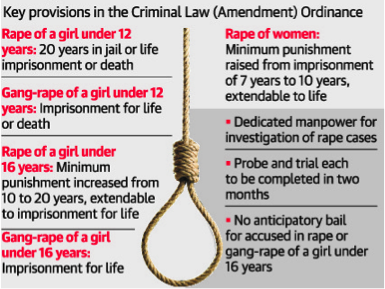
Now, noting the major present updates made to the level of toughness in the Indian Rape Laws by the virtue of Criminal Law (Amendment) Ordinance, 2018 which has provided the following amendments to the Indian Penal Code 1860(I.P.C.), Indian Evidence Act 1872 (I.E.A.), Code of Criminal Procedure 1973(Cr.P.C.) and Prevention of Children from Sexual Offences Act 2012(P.O.C.S.O).

IMAGE 1: Glimpses of Criminal Law (Amendment) Ordinance, 2018.

1.    Amendment to I.P.C.

  • Section 376 IPC: Minimum Punishment for Rape has been increased from 7 years to 10 years and the Maximum punishment remains the same, i.e. Imprisonment for Life.
  • Section 376 sub-section (3) is incorporated which prescribes the Minimum punishment of 20 years to a man committing rape on a woman (how a girl below 16 years of age be considered as women- highly discrepancy shown in this section) under Sixteen years of Age.
  • Section 376AB has been newly inserted which prescribes the minimum punishment of 20 years rigorous imprisonment to a person committing rape on a woman under 12 years of Age. Death Penalty is the maximum prescribed punishment in this respect.
  • Section 376DA and 376DB provide minimum punishment of Life Imprisonment for persons involved in gang rape of a woman aged less than 16 years and 12 years, respectively. Moreover, Capital Punishment is also prescribed for persons involving in gangrape with women under 12 years of age.
  • Section 376 (2) (a), the sentence “within the limits of the police station to which such police officer is appointed” has been omitted. This omission implies, no matter where a Police officer commits rape, he is to be punished with rigorous imprisonment of minimum 10 years.

2. Amendment to Cr.P.C.

  • Section 173 is amended to provide that investigation in relation in all Rape cases may be completed within two months from the date on which the information was recorded by the officer in charge of the police station.
  • Section 374 of Cr.P.C. have also been amended to insert a sub-section which prescribes six months’ time to dispose of an appeal in rape cases.
  • Sub-section (4) of Section 438 is amended to incorporate that, No Anticipatory bail can be granted to a person accused of rape of girls of age less than 16 years.
  • Section 439 is amended to include the presence of informant or any person authorized by him at the time of hearing an application for bail to a person accused of rape of girls of age less than sixteen years.

3.    Amendment to POCSO Act

  • Section 42 of the POCSO Act has been also amended to include newly inserted IPC provisions section 376AB, section 376DA, and section 376DB.

In spite of the fact that we have such tough laws to prevent the commission of the crimes against women, we hear at a day-to-day level that in one portion or the other of our beautiful nation many cases of rapes are recorded. The main culprits which are found behind these tragic incidents in my view may include, firstly, the inefficiency of the Police force as well as the law enforcement agencies; Secondly, the delay in getting justice and disposal of cases may be categorised as other reason for non-decrease in the level of rapes, because the culprit is well aware of the fact that he will not be convicted in these cases in a day or two which has significantly risen the confidence of such delinquents or criminals.

Therefore, we the real sovereigns and our representatives should keep in their mind that making stringent laws is not a solution but the realisation of one’s duty should be the motive for effective implementation and execution of the law.

With this, I conclude this write-up by putting a question to ponder about, which the recent rape laws has not answered yet, and ultimately will result in another promulgation of a similar law titled as ‘Criminal Law (Amendment)….’ after witnessing another insensitive incident, on the following questions,

  1. Are Men never Raped?
  2. Are married women a tool for satisfying sexual desires?

Hope so, we get an answer to these questions in future amendments, because the answer to these questions will pave way for future amendments.

References

K.M. Ashok, Death for Child Rape- The Criminal Law Amendment Ordinance 2018: Promulgated, LIVE LAW (July 24, 2018, 07: 55 PM), http: //www.livelaw.in/death-child-rape-criminal-law-amendment-ordinance-2018-promulgated-read-salient-features-read-ordinance/.


Contributed by

Harshit Sharma,
4th Year, B.A., LL.B.(Hons.),
Amity Law School,
Amity University Madhya Pradesh

L. Jose Vs. K. Nesamony [Kerala High Court, 141994]

IN THE HIGH COURT OF KERALA AT ERNAKULAM K. Paripoornan andK, Joseph, JJ. January 14, 1994 L. Jose vs K. Nesamony and Ors. JUDGMENT K. J. Joseph, J. 1. The 5th respondent in O.P. No. 7573 of 1989 is the appellant in this appeal. The first respondent in the appeal had filed the above original petition challenging the validity of Ex …

Read more at Case Laws

V.A. Abraham Vs. Superintendent of Police [Kerala High Court, 141988]

IN THE HIGH COURT OF KERALA AT ERNAKULAM Hon’ble Mr.Justice S. Padmanabhan V.A. AbrahamVs.Superintendent Of Police Crl.A. No. 453 of 1986 14-01-1988 Advocates:For Appellant: V. Radhakrishnan Menon, P. Gopinath;For Respondent: T.R. Raman Pillai, Public Prosecutor. JUDGMENT S. Padmanabhan, J. 1.The Special Judge (SPE/CBI …

Read more at Case Laws

Mangesh Vs. State of Maharashtra [Supreme Court of India, 052011]

IN THE SUPREME COURT OF INDIA CRIMINAL APPELLATE JURISDICTION P. SATHASIVAM AND Dr. B.S. CHAUHAN, JJ. January 5, 2011 CRIMINAL APPEAL NO. 14 of 2011 (Arising out of SLP(Crl.) No. 1981 of 2010) From the Judgment & Order dated 25.8.2009 of the High Court of Bombay at Nagpur Bench, Nagpur in Criminal Appeal No. 242 of 2004. For th …

Read more at Case Laws

Indo Rama Synthetics (I) Ltd. Vs. C.I.T., New Delhi [052011] SC

IN THE SUPREME COURT OF INDIA CIVIL APPELLATE JURISDICTION S. H. Kapadia (CJI), K.S. Panicker Radhakrishnan and Swatanter Kumar, JJ. January 5, 2011 Civil Appeal No. 33 of 2011 (Arising out of S.L.P. (C) No. 35133 of 2009) From the Judgment & Order dated 22.9.2009 of the High Court of New Delhi at Delhi in ITA No. 851 of 2009. …

Read more at Case Laws

Narwinder Singh Vs. State of Punjab [Supreme Court of India, 052011]

IN THE SUPREME COURT OF INDIA CRIMINAL APPELLATE JURISDICTION B.SUDERSHAN REDDY AND SURINDER SINGH NIJJAR, JJ. JANUARY 05, 2011 CRIMINAL APPEAL NO. 590 OF 2005 From the Judgment and Order dated 6.10.2004 of the High Court of Punjab and Haryana at Chandigarh in Criminal Appeal No. 406-SB of 1992. For the Appellant:-. V.C. Mahajan S …

Read more at Case Laws